
October Research Highlights Why Nicotine Salt Chemistry Matters in Emissions Testing
October Research Highlights Why Nicotine Salt Chemistry Matters in Emissions Testing
October Research Highlights Why Nicotine Salt Chemistry Matters in Emissions Testing
October Research Highlights Why Nicotine Salt Chemistry Matters in Emissions Testing
New October research adds to the evidence that aerosol measurements depend on composition and test conditions. Here is how to read the findings in context.
A study published in Tobacco Control on 19 October 2026 adds to the evidence that nicotine salt chemistry matters in e-cigarette emissions testing. Its findings also raise a broader question: what information must accompany a laboratory result before readers can interpret it? Earlier research helps explain why test conditions deserve equal attention. [1]
October Research Highlights Why Nicotine Salt Chemistry Matters in Emissions Testing(1)
What the October study adds
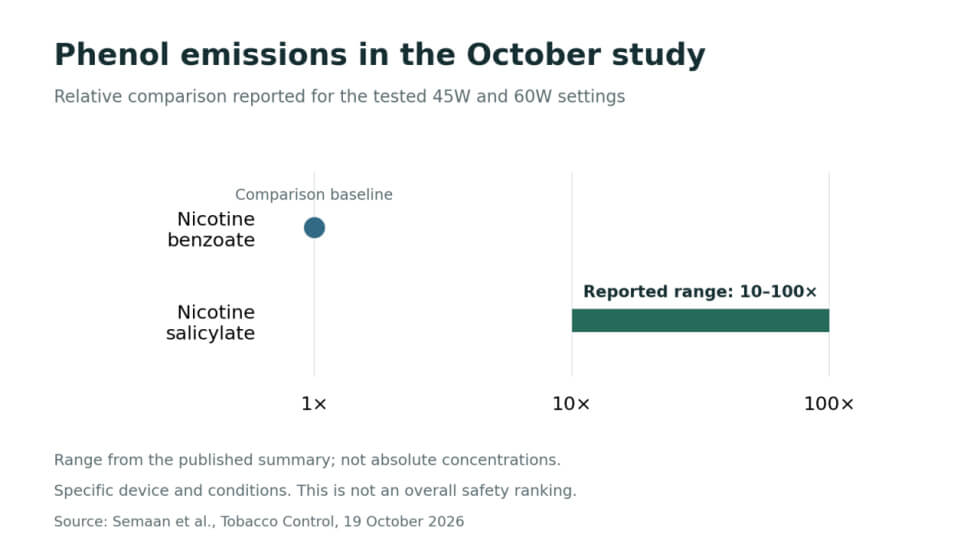
The researchers compared nicotine salicylate and nicotine benzoate in a sub-ohm e-cigarette. Their published summary reports that nicotine salicylate produced phenol emissions one to two orders of magnitude higher at the tested settings of 45 and 60 watts. [1]
That comparison should remain attached to its experimental context. It does not establish a universal relationship across every device, formulation or operating condition. Nor does a lower result for one measured substance demonstrate overall product safety.
October Research Highlights Why Nicotine Salt Chemistry Matters in Emissions Testing(2)
Composition is one part of a larger picture
A separate study published in Chemical Research in Toxicology on 6 February 2026 examined eight flavouring chemicals from four chemical classes. The researchers varied operating power, base-liquid composition and flavouring concentration. Their results showed that carbonyl emissions depended on interactions among these factors. [2]
For readers, the practical implication is that a broad label such as ‘flavoured’ or ‘nicotine salt’ cannot fully describe a test sample. The identity of the measured substance and the conditions used to generate the aerosol both matter. Comparisons become less informative when this information is missing.
October Research Highlights Why Nicotine Salt Chemistry Matters in Emissions Testing
A ‘per-puff’ value needs its protocol
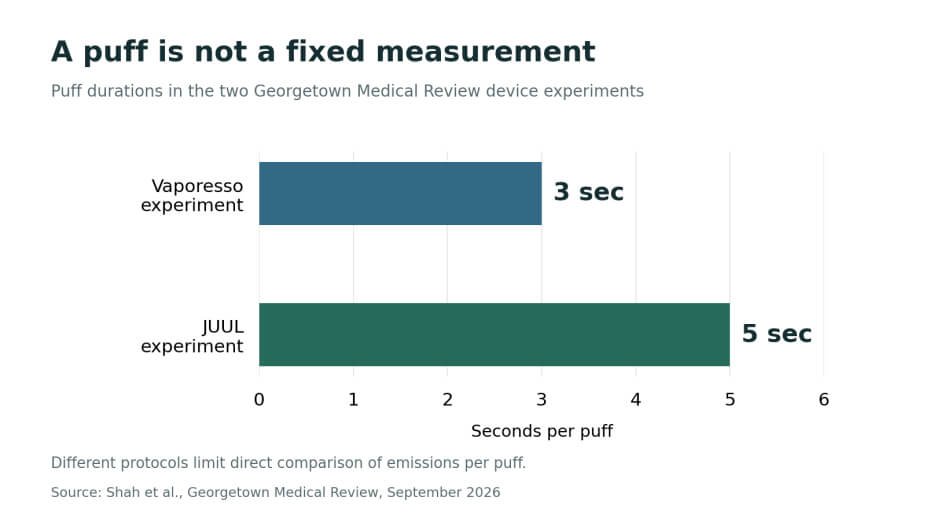
A study published in Georgetown Medical Review in September 2026 illustrates another limitation. Its two device experiments used different puff durations: three seconds for one and five seconds for the other. The authors explicitly identified puff duration, liquid composition and other differences as obstacles to attributing the results solely to device power. [3]
The study also used device-specific detection limits. Some measurements at or below those limits were replaced with the limit value when calculating summary statistics. [3]
These details change how a table should be read. A result below a method’s detection limit is not a measurement of zero. Likewise, two values expressed in micrograms per puff are not automatically comparable when ‘a puff’ represents different collection conditions.
October Research Highlights Why Nicotine Salt Chemistry Matters in Emissions Testing (2)
What clearer reporting should include
Our editorial recommendation is to present the measured results alongside a short methods summary: the device and sample identity, operating settings, puff duration and sampling procedure, analytical method, detection limits and number of independent samples.
Reports should also separate observations from interpretation. If several experimental conditions changed together, the article should say so before suggesting that one factor explains the difference. Where findings concern a specific laboratory setup, that boundary belongs beside the conclusion.
Reading emissions research this way gives a more complete picture than an isolated headline number: what was measured, what the evidence supports and what remains unresolved.
Sources
[1] Tobacco Control / BMJ. Nicotine salt acid choice influences phenol emissions in a sub-ohm e-cigarette: salicylate versus benzoate — 2026-10-19
[2] Chemical Research in Toxicology / American Chemical Society. Flavoring Compound Chemical Class and Vaping Conditions Determine Toxic Carbonyl Emissions from E-Cigarettes — 2026-02-06
[3] Georgetown Medical Review. Potential Influence of Flavoring Compounds on Aldehyde Production in Electronic Cigarette Aerosol: Case Studies of 3rd and 4th Generation Devices — 2026-09-10